
For furniture manufacturers, modular kitchen makers, and industrial woodworkers, time is literally currency. Every cut matters. A millimeter off can ruin an entire sheet of expensive plywood, MDF, or particle board, eating directly into your profit margins.
When it comes to scaling production and maximizing your workshop’s Return on Investment (ROI), upgrading your cutting machinery is inevitable. But it leads to a critical crossroad: Should you invest in a Vertical Panel Saw or a Horizontal Panel Saw (Sliding Table Saw)?
At Kataria Tech Zone (Amritsar), we help woodworkers choose machinery that perfectly balances floor space, labor costs, budget, and output requirements. Let’s break down the core differences between these two workhorses so you can make the high-ROI decision for your workshop.
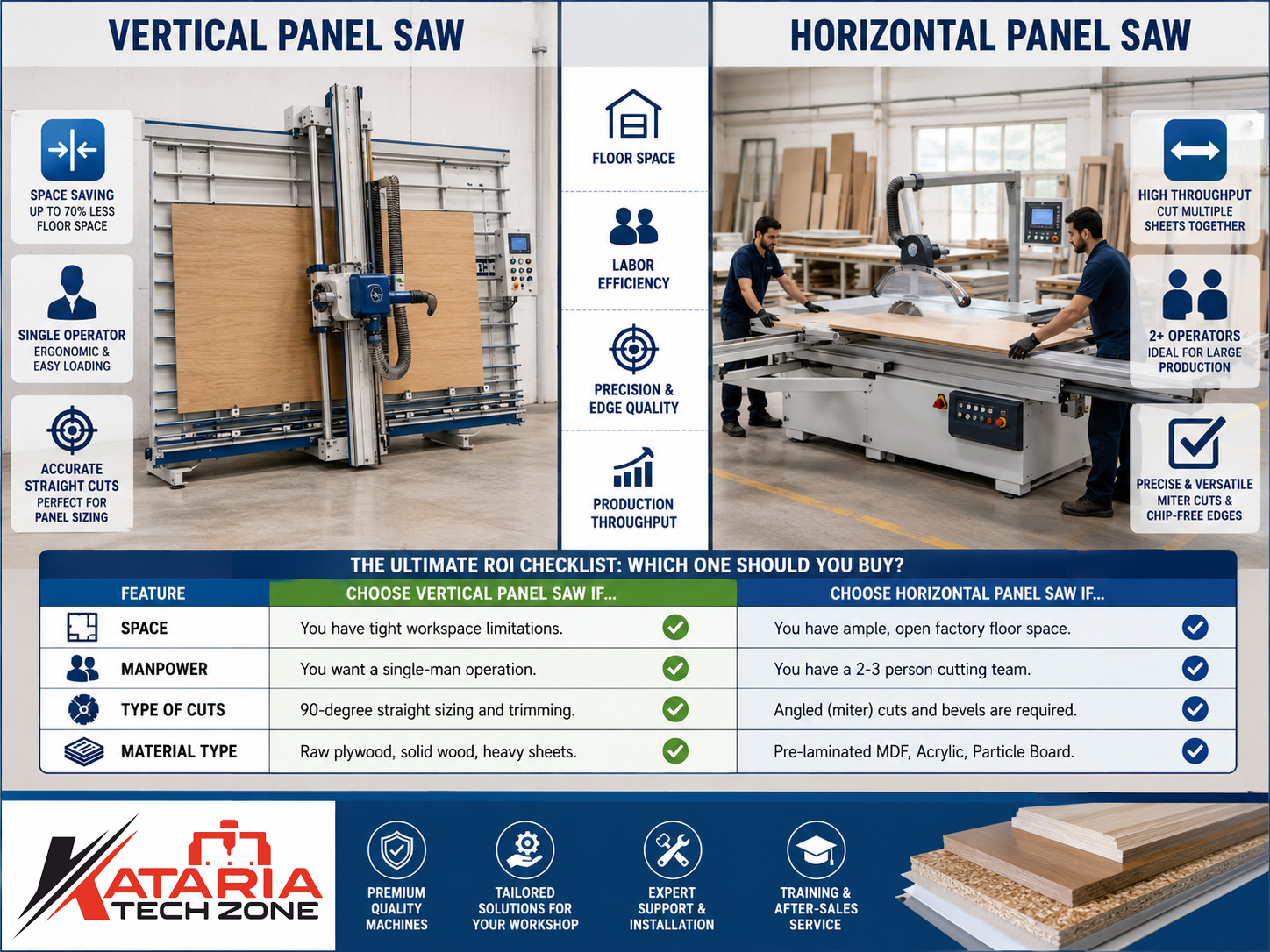
1. The Real Estate Battle: Workshop Floor Space
Floor space is often the most expensive asset in an industrial unit or workshop. Maximizing production per square meter is key to a high ROI.
- Horizontal Panel Saw: These machines have a large footprint. Because the sheet travels horizontally across a sliding table, you need free space equal to at least twice the length of your largest board, both in front of and behind the blade. A standard horizontal saw can easily consume 200 to 300 square feet of usable floor area.
- Vertical Panel Saw: If space is tight, the vertical saw is a game-changer. The machine stands upright, leaning slightly against a wall. The material remains static while the saw blade moves vertically and horizontally. This reduces the required footprint by up to 70% compared to a horizontal saw.
The ROI Verdict: If you are paying high rent or working in a compact setup in Amritsar’s bustling industrial hubs, a Vertical Panel Saw saves valuable floor space that can be utilized for edge-banding, assembly, or finished goods storage.
2. Labor Efficiency and Operator Fatigue
Labor costs and worker fatigue drastically impact daily output.
- Horizontal Panel Saw: Handling a full 8×4 feet heavy commercial plywood sheet horizontally usually requires two operators—one to feed the machine and another to catch the cut piece. Lifting heavy panels repeatedly throughout an 8-hour shift leads to worker fatigue, slower production toward the end of the day, and an increased risk of workplace injuries.
- Vertical Panel Saw: Gravity is your friend here. Loading a sheet vertically onto a roller-bearing bottom support is highly ergonomic. A single operator can easily load, slide, and cut large panels alone.
The ROI Verdict: A Vertical Panel Saw wins on labor efficiency. It cuts your manpower requirement in half for the cutting process, allowing you to reallocate labor to other high-value tasks like assembly or finishing.
3. Cutting Precision and Edge Quality
When manufacturing modular furniture, perfect right angles and chip-free edges are non-negotiable for seamless edge-banding.
- Horizontal Panel Saw (Sliding Table Saw): Horizontal saws excel in high-precision, varied cutting. They feature a primary blade and a secondary scoring blade that spins in the opposite direction. This scoring blade ensures completely chip-free cuts on delicate materials like pre-laminated MDF, particle board, and acrylic sheets. Furthermore, horizontal saws easily handle miter (angled) cuts, which are essential for custom furniture pieces.
- Vertical Panel Saw: While modern vertical saws offer incredible accuracy for straight trimming and sizing, standard models do not comfortably handle complex miter or angled cuts. While scoring units are available on high-end vertical saws, the horizontal format remains the industry standard for flawless beveling.
The ROI Verdict: If your workshop specializes in high-volume, straight panel sizing, a vertical saw is excellent. However, if your business thrives on custom designs, angled joints, and working extensively with double-sided laminated boards, a Horizontal Sliding Table Saw delivers a better ROI by eliminating edge chipping and manual rework.
4. Production Volume and Material Throughput
How many sheets do you need to process per day?
- Horizontal Saw: If you are running high-production shifts, a horizontal saw allows operators to stack multiple sheets on top of each other and cut them simultaneously, dramatically increasing throughput.
- Vertical Saw: Vertical saws are highly optimized for fast, repetitive, individual sheet cutting. While some heavy-duty industrial models allow sheet stacking, they are generally preferred for fast, precise single-sheet processing.
The Ultimate ROI Checklist: Which One Should You Buy?
To make the final choice, evaluate your business against this quick checklist:
| Feature | Choose Vertical Panel Saw If… | Choose Horizontal Panel Saw If… |
| Space | You have tight workspace limitations. | You have ample, open factory floor space. |
| Manpower | You want a single-man operation. | You have a 2-3 person cutting team. |
| Type of Cuts | 90-degree straight sizing and trimming. | Angled (miter) cuts and bevels are required. |
| Material Type | Raw plywood, solid wood, heavy sheets. | Pre-laminated MDF, Acrylic, Particle Board. |
Maximize Your ROI with Kataria Tech Zone
Choosing the right machinery is an investment in your business’s future. Selecting the wrong saw can lead to bottlenecked production, wasted material, or cramped floor space.
At Kataria Tech Zone, Amritsar, we don’t just sell woodworking machinery—we deliver tailored industrial solutions. Whether you need a heavy-duty Horizontal Sliding Table Saw for high-precision modular furniture or a space-saving Vertical Panel Saw to optimize your layout, our expert team is here to guide you.
Ready to upgrade your workshop’s productivity?
Visit our showroom in Amritsar or browse our latest inventory online at katariatechzone.com. Contact our experts today for a personalized machinery consultation and live demonstrations!



2 thoughts on “Maximizing Workshop ROI: How to Choose Between a Vertical and Horizontal Panel Saw”